
 Image 1 of 1
April along the Wenatchee River still carries the last chill of early spring, even when the days are warming. At Wenatchee Confluence State Park the shoreline is a mix of sand, small stones, and scattered bits of driftwood. While I was walking the edge of the water I came across a pair of Canada Geese with their young. One of the adults had settled onto the open sand, body lowered and wings relaxed.
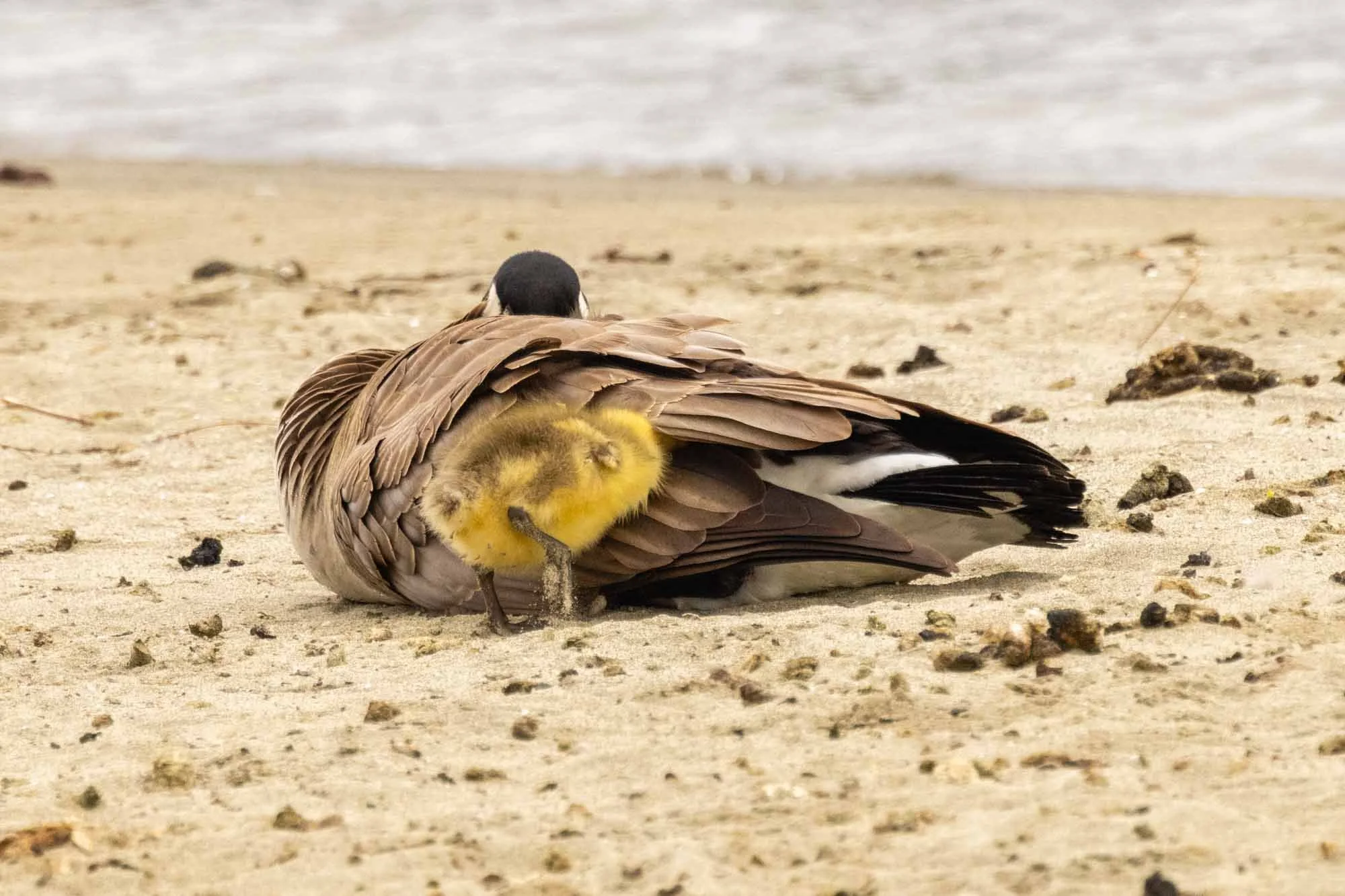
The goslings stayed close at first, standing on the sand and watching the resting parent. After a few minutes one of them walked over and began to push its way under the curve of the wing. The adult stayed still and let it. Once the first gosling was mostly tucked in, only its yellow head and part of its back still visible, the second gosling followed. It climbed in beside the first, disappearing into the same feathered pocket until both were sheltered against the parent’s body.
Canada Geese are precocial. Unlike many songbirds that hatch helpless, blind, and naked, goose goslings emerge from the egg already covered in down, with eyes open and the ability to walk, swim, and feed themselves within about 24 hours. That early independence is useful—it lets the family leave the nest quickly and move to feeding areas—but it does not mean the young are fully self-sufficient. For the first several weeks they still depend on their parents for two critical things: protection from predators and help with temperature regulation.
The bright yellow natal down is excellent camouflage among spring grasses and shoreline vegetation, yet it is not as insulating as the feathers that will replace it. On cooler mornings the goslings lose heat quickly when they are exposed. That is why they so readily crowd against an adult or work their way under a wing. The parent’s body becomes both a heat source and a safe place while the young birds continue to grow. Over the next weeks the yellow fades, the first real feathers appear, and the goslings gradually need less physical contact for warmth. Until then, moments like this—climbing one by one into the shelter of a parent’s wing—are a normal and necessary part of their development.
I stayed back and watched. After a while the goslings began to shift and one of them emerged, then the other. The adult remained settled on the sand, head up, keeping an eye on the shoreline. It was a quiet moment, the kind you only notice when you slow down and wait: the young birds treating their parent as both shelter and anchor while they learn the edges of the river.