
 Image 1 of 1
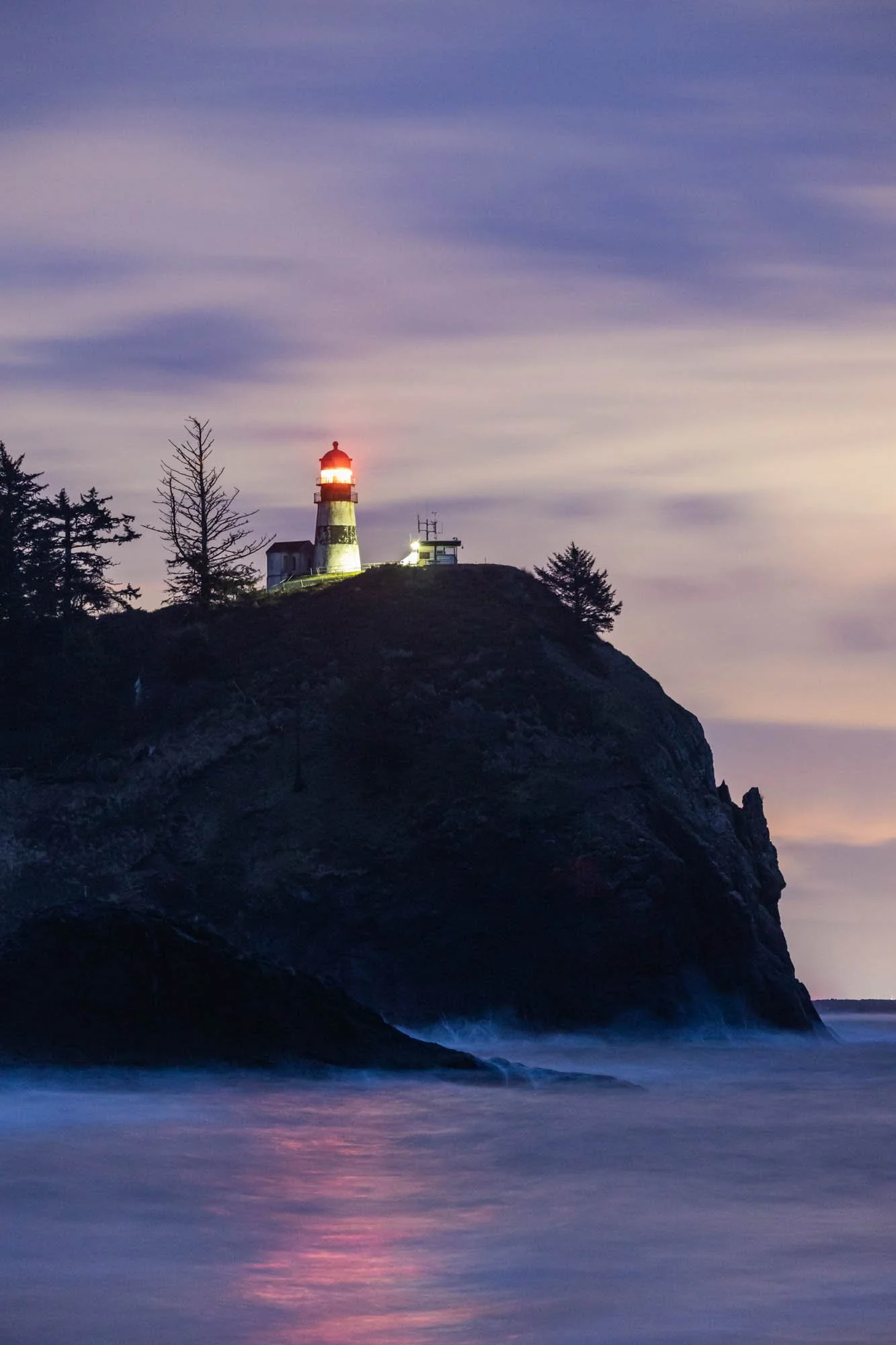
On my first visit to Cape Disappointment I arrived at the viewpoint well before sunrise. In the pitch-black darkness with no moon, the only light came from the lighthouse itself. Its bright beam swept the area, briefly revealing slivers of the headland and water and giving a preview of the scene that would soon emerge.
With nothing to do but wait, I began experimenting with combining the lighthouse, water, and sky into a single frame. I could only see the composition through the live view on the back of the camera. I framed what I wanted and made several multi-second exposures. It felt like a fun exercise at the time — I didn’t really expect to use the results.
Back at the hotel I was surprised by the detail. The long exposure flattened the waves into an almost smooth surface while the bright, colorful beam of the lighthouse painted the water. There is a haunting quality to the lonely moment: the lighthouse standing alone in the dark on the early-morning headland, long before the sun rises.
Cape Disappointment stands at the mouth of the Columbia River in Washington, a place long known as one of the most dangerous stretches of water on the West Coast — the “Graveyard of the Pacific.” The cape itself was named in 1788 by British trader John Meares, who failed to recognize the river entrance and sailed away disappointed. Lewis and Clark reached the area in November 1805. Because of the high number of shipwrecks, Congress authorized a lighthouse here as one of the first on the West Coast. After an initial shipment of materials was lost when the bark Oriole wrecked on the bar in 1853, construction finally proceeded. The 53-foot masonry tower was completed and first lit on October 15, 1856, making it the oldest operating lighthouse in the Pacific Northwest. Originally fitted with a first-order Fresnel lens (later moved to North Head Lighthouse), it has guided vessels past the shifting Columbia River Bar for more than 165 years. The original lens is now displayed at the nearby Lewis and Clark Interpretive Center.