
November 21st, 2026
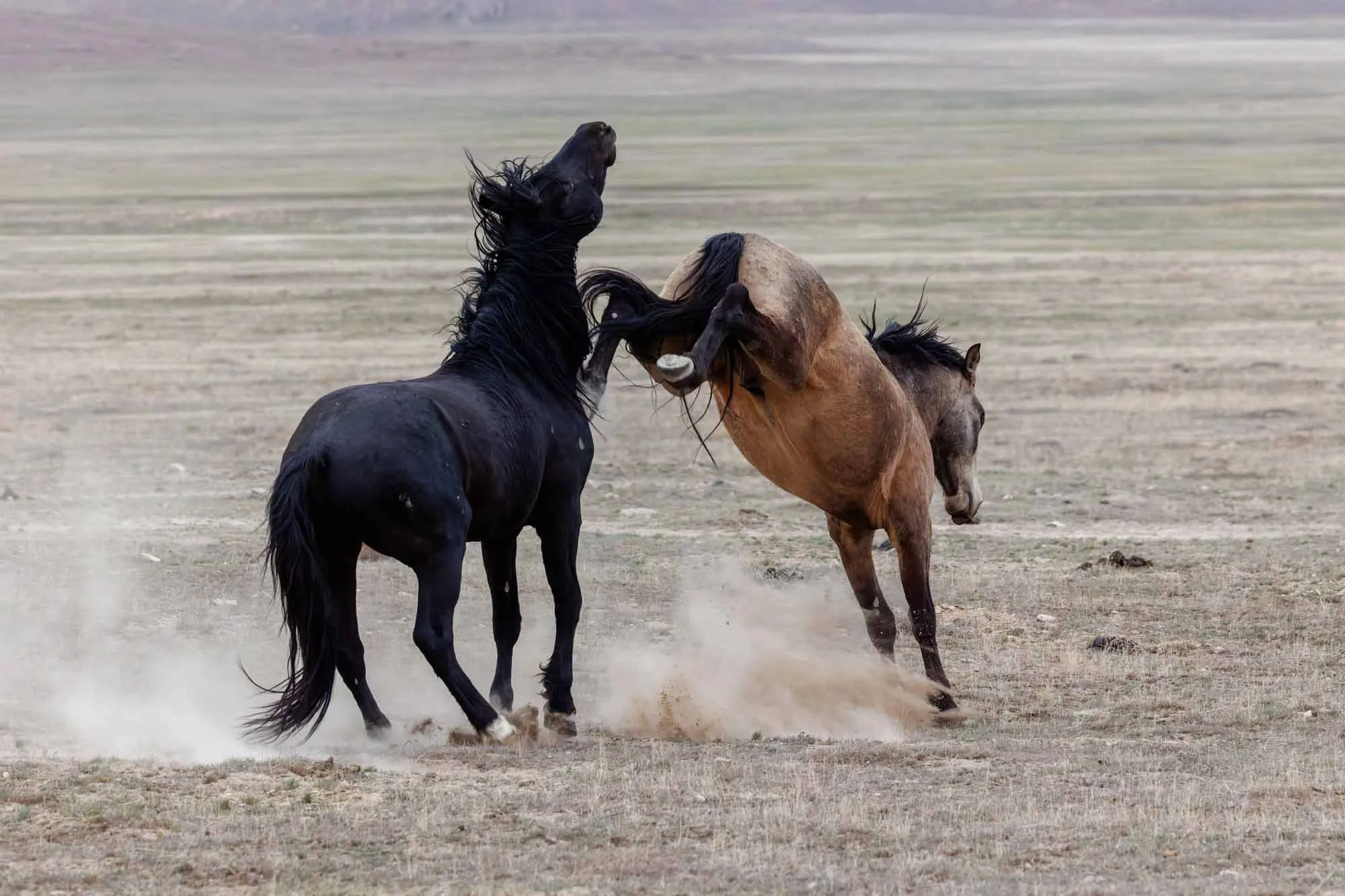
Two wild stallions trade places in a prolonged fight on open Utah rangeland. The lighter horse rears as the black stallion presses in, and a kick lands near the head after minutes of bites and lunges that never quite connected.
Wild Horses (Mustangs) do not always have a one-sided dominance play interaction. Sometimes the horses fight back and forth and trade bites and kicks. In the case of these two horses they interacted back and forth for a while but never quite landed a hit until one moment when it looked like the current pursuer got kicked in the head when that pursuer was about to get a bite.
The black horse and the lighter one had been circling and surging at each other across the open ground. One would press forward with neck arched and teeth bared, the other would spin or rear and answer with a kick or a lunge. Dust kicked up under their hooves as they traded places—pursuer becoming pursued, then reversing again. It went on longer than a quick warning display. Neither horse fully gave ground. They stayed close enough that a solid connection looked inevitable, yet each time one closed in the other turned just enough to keep the teeth or the hoof from landing cleanly. Then the lighter horse reared and the black horse drove in. In that instant the kick came down near the head of the horse that had been pressing the attack. The contact looked real. After that the intensity dropped and the two horses separated, still moving but no longer locked in the same tight exchange.
Stallion confrontations among free-ranging horses often follow this pattern. Most of the time the threat is enough—ears back, neck snake, a short chase. When neither animal yields, the fight can shift into physical contact: bites to the neck and shoulders, rearing and striking with the front legs, or a hind-leg kick. The risk is real; a well-placed kick or bite can injure a leg or a jaw. That is why many encounters stay at the display stage. When they do escalate, the action can reverse quickly as each horse tries to land a hit while avoiding one.
These moments are becoming harder to see in the open. Wild horse numbers on BLM-managed lands have declined in recent years after years of growth well above what the agency considers sustainable. As of early 2026 the estimated population stood around 85,000 animals against an Appropriate Management Level of roughly 26,000. Herds can still double every four to five years because there are few natural predators, but repeated gathers, fertility control, and drought have reduced the on-range total from peaks near 95,000. The horses that remain continue to move across the same dry basins and open ranges, still settling hierarchy the same way—through long, back-and-forth contests that only occasionally end with a solid kick or bite.
Bringing the Moment to Life
Dust rises as the lighter stallion rears and the black horse closes in, the moment a kick lands near the head after a long back-and-forth exchange on the open Utah range.
In our studio, I produced this photograph using our Canon imagePROGRAF PRO-1100 and archival Lucia PRO II pigment inks. When printed on Red River Polar Gloss Metallic paper, the details of the subject are incredible, with smooth tonal depth. The metallic paper beautifully handles those subtle midtones and the texture of the horses’ coats and flying manes, making the scene pop off the paper without losing any fine detail in the dust or landscape.
Printed with an elegant white border for safe handling and a classic gallery presentation, this piece is flat-shipped in extra-rigid packaging to protect its premium reflective finish.
Bring the story home: Shop Mustang Kick Print
Print Details: Available in 8.5" x 11" Paper (7" x 9" Image) and 11" x 17" Paper (10" x 15" Image).