
November 23rd, 2026
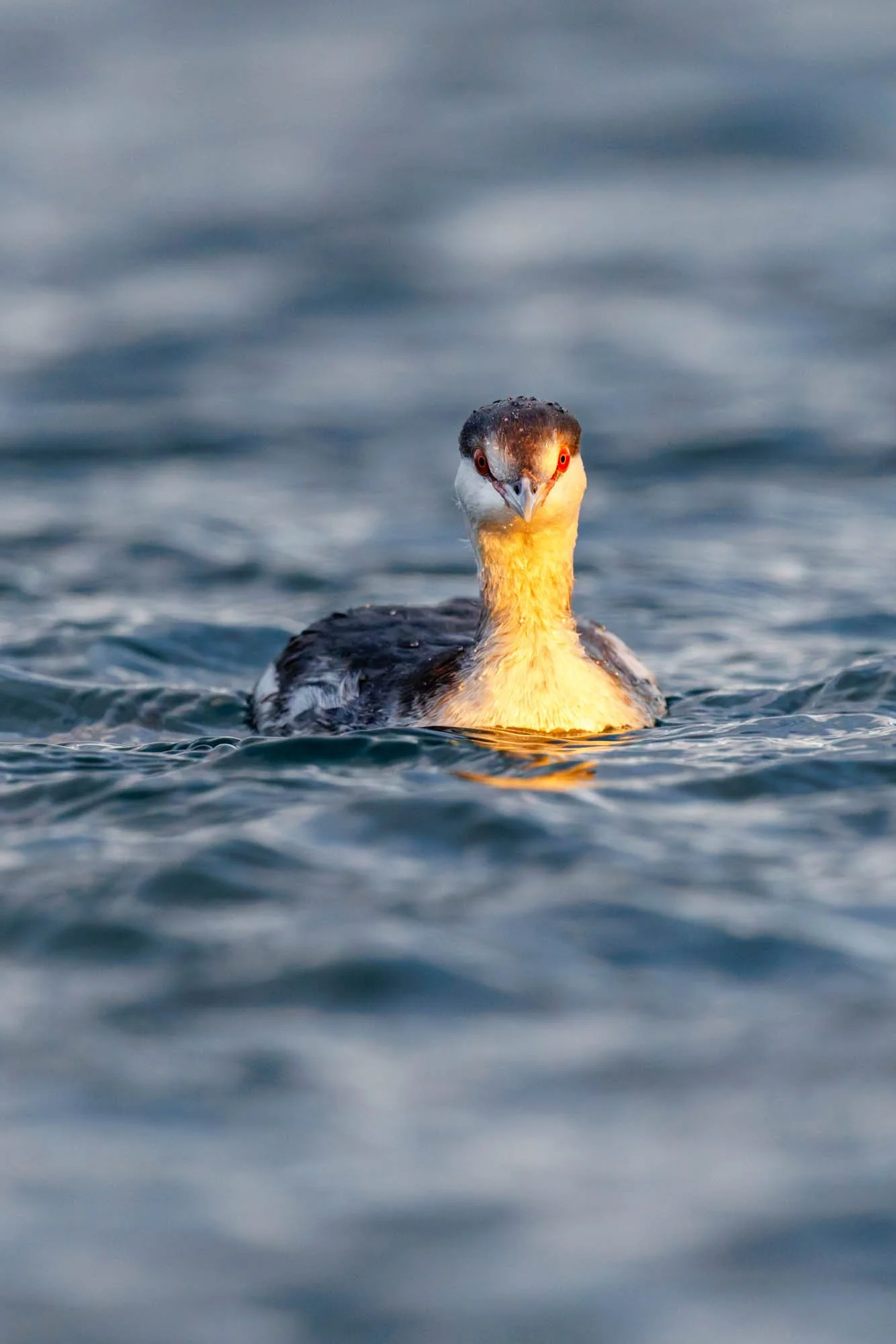
Horned Grebe giving me the eyeball at Semmiahmoo Spit
While walking along the shore of Semiahmoo Spit, there was a single Horned Grebe that kept fishing nearby. He seemed completely unconcerned by my presence and kept close by. The fishing must have been great because he kept trying. I did not need to move much at all as the bird kept pretty close to where I was sitting on the shore. At one point he stared right at me.
Horned Grebes catch prey by diving. In winter they work the shallow to moderately deep nearshore water, usually less than about six meters. They propel themselves with the lobed feet set far back on the body and chase small fish, crustaceans, and marine worms. Small items are swallowed underwater. Larger fish are brought to the surface, pinched and turned head-first, then swallowed. Dives commonly last around twenty seconds. The bird in the frame is in non-breeding plumage: dark crown, clean white cheek, red eye, and pale tip on the bill. That is the look they wear from roughly October through March while they are on the coast.
They stay close to shore at places like Semiahmoo Spit because the protected shallows concentrate the small fish and invertebrates they need. The spit and the adjacent harbor offer calm, shallow water with easy access to prey and a shoreline where people are a regular presence. Many of the wintering birds become relatively approachable. The combination of food and low disturbance is what kept this individual working the same stretch of water while I sat still.
Pairs form in late winter or on spring migration. Most Horned Grebes that winter along the Washington coast breed on shallow freshwater ponds and marshes in Alaska, northern British Columbia, and the prairie provinces. They arrive on the breeding grounds from mid-May onward, build floating nests of wet vegetation anchored among emergent plants, and raise one brood. Both parents incubate and feed the young, which often ride on a parent’s back. Breeding records in Washington itself are rare and limited mostly to a few sites in the eastern part of the state. By late summer the birds molt into non-breeding plumage and return to the coast, where they remain until spring.
Bringing the Moment to Life
The warm light really brings out the details of this Horned Grebe as it floats close to shore, red eye fixed on the camera and chest glowing against the cool water.
In our studio, I produced this photograph using our Canon imagePROGRAF PRO-1100 and archival Lucia PRO II pigment inks. When printed on Red River Polar Gloss Metallic paper, the details of the subject shine in incredible, smooth tonal depth. The metallic paper beautifully handles those subtle midtones and the soft golden light on the chest against the dark crown and white cheek, making the scene pop off the paper without losing any fine detail in the feathers or the water surface.
Printed with an elegant white border for safe handling and a classic gallery presentation, this piece is flat-shipped in extra-rigid packaging to protect its premium reflective finish.
Bring the story home: Shop Horned Grebe Print
Print Details: Available in 8.5" x 11" Paper (7" x 9" Image) and 11" x 17" Paper (10" x 15" Image).