
November 27, 2026
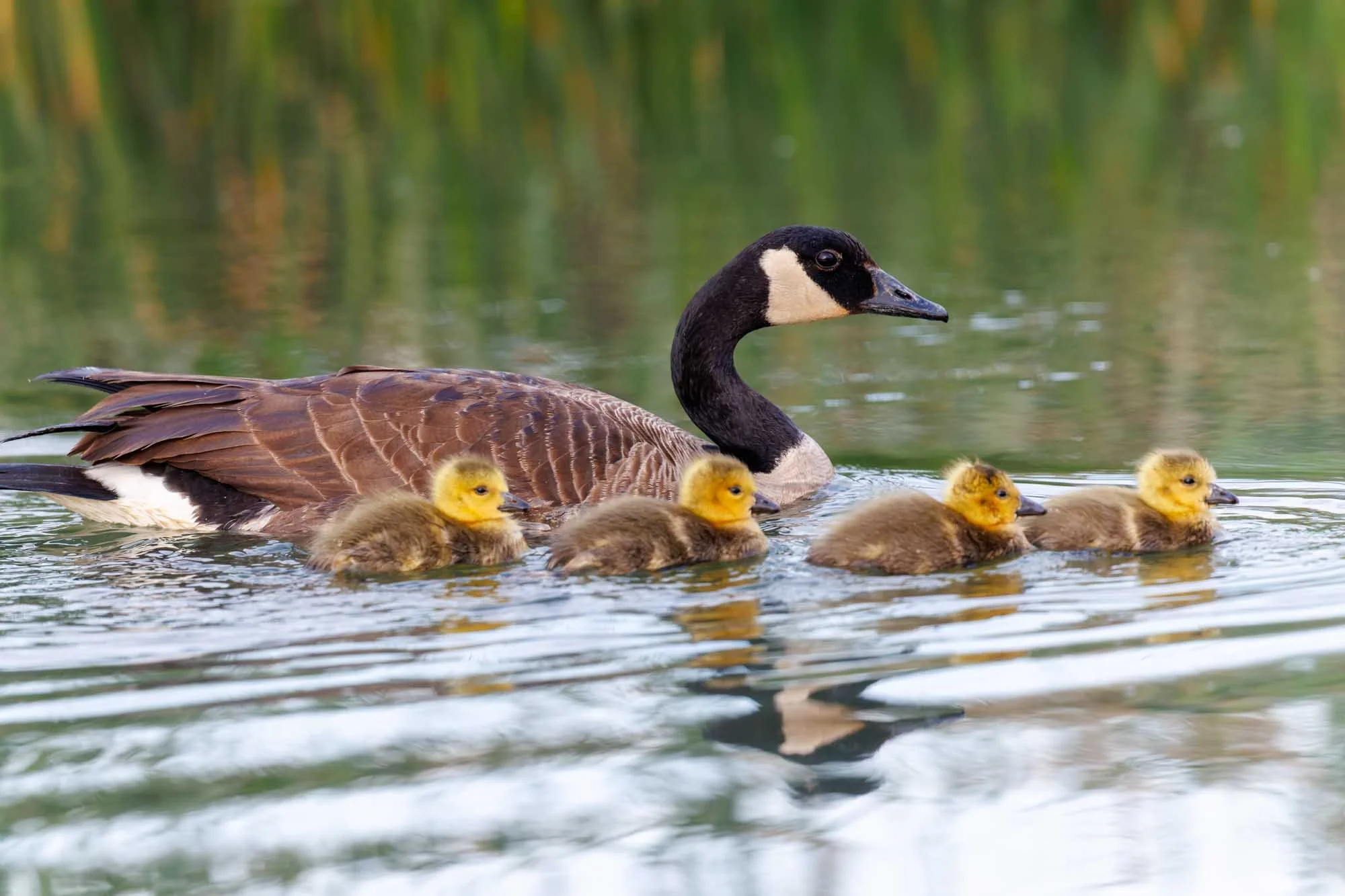
Spring brings the next generation in the animal world. It is an exciting time to be outside and finding them in different places around you. In this case an early walk in May brought a brood of Canada Geese parents and their young. According to what we have read, these babies were barely a week old. They appeared on the edge of the water in Wylie Rd. They wandered around the area and then disappeared into the brush. I took this shot of one of the parents as they wandered back and forth close to the edge of the trail. They didn't seem to have any particular purpose in mind, just a wander back and forth until for some reason they decided to go into the brush. There was little concern about me as I sat there and photographed them.
Canada Goose goslings are precocial. They hatch with eyes open, a full coat of yellow down, and the ability to walk, swim, and feed themselves within a day. At roughly a week old they are still small, still mostly yellow with darker markings on the crown and back, and still fully dependent on the adults for protection and guidance. Both parents stay with the brood. The adults do not feed the young; they lead them to suitable areas where the goslings can graze on grass and other vegetation.
The back-and-forth movement without obvious feeding is typical of young broods. The parents keep the goslings moving between the water’s edge and nearby cover. This serves several purposes: it lets the young stretch and strengthen their legs, it keeps the family together in a loose formation, and it allows the adults to assess the surroundings. Goslings tire quickly and chill easily in the first days, so short periods of travel alternate with rest. The adults also use the movement to keep the brood near escape routes into the water or brush if a threat appears. In this case the family simply continued its slow circuit until the adults chose to enter the vegetation.
Wylie Road is a local road in the Stanwood area of Snohomish County. Stanwood sits at the mouth of the Stillaguamish River. The Stillaguamish people lived in the delta for thousands of years; at the time of the 1855 Point Elliott Treaty a village stood near the present town site. American settlement began as Centerville in 1866 with a trading post on the south side of the river. The settlement moved to the north bank, gained a post office, and in 1877 postmaster D. O. Pearson renamed it Stanwood after his wife Clara’s maiden name. He also built a store and a steamboat wharf. Loggers cleared the surrounding forest; farmers drained the marshland for agriculture. The Great Northern Railway bypassed the waterfront in 1890–91 and a second town, East Stanwood, grew a mile east around the depot. Stanwood incorporated in 1903; East Stanwood incorporated later; the two towns consolidated in 1960. The low, wet ground and water edges that remain along roads like Wylie Road still provide the shallow margins and grassy cover Canada Geese use for raising young. The combination of open water, trail-edge vegetation, and relatively quiet early-morning conditions is what makes these brief encounters possible.
Bringing the Moment to Life
The soft morning light really brings out the details of this Canada Goose family as the adult’s dark neck and white cheek patch sit above four yellow goslings in the calm water.
In our studio, I produced this photograph using our Canon imagePROGRAF PRO-1100 and archival Lucia PRO II pigment inks. When printed on Red River Polar Gloss Metallic paper, the details of the subject shine in incredible, smooth tonal depth. The metallic paper beautifully handles those subtle midtones and the soft yellow down of the goslings against the darker adult, making the scene pop off the paper without losing any fine detail in the feathers or the water.
Printed with an elegant white border for safe handling and a classic gallery presentation, this piece is flat-shipped in extra-rigid packaging to protect its premium reflective finish.
Bring the story home: Shop Canada Goose Print
Print Details: Available in 8.5" x 11" Paper (7" x 9" Image) and 11" x 17" Paper (10" x 15" Image).