
November 26th, 2026
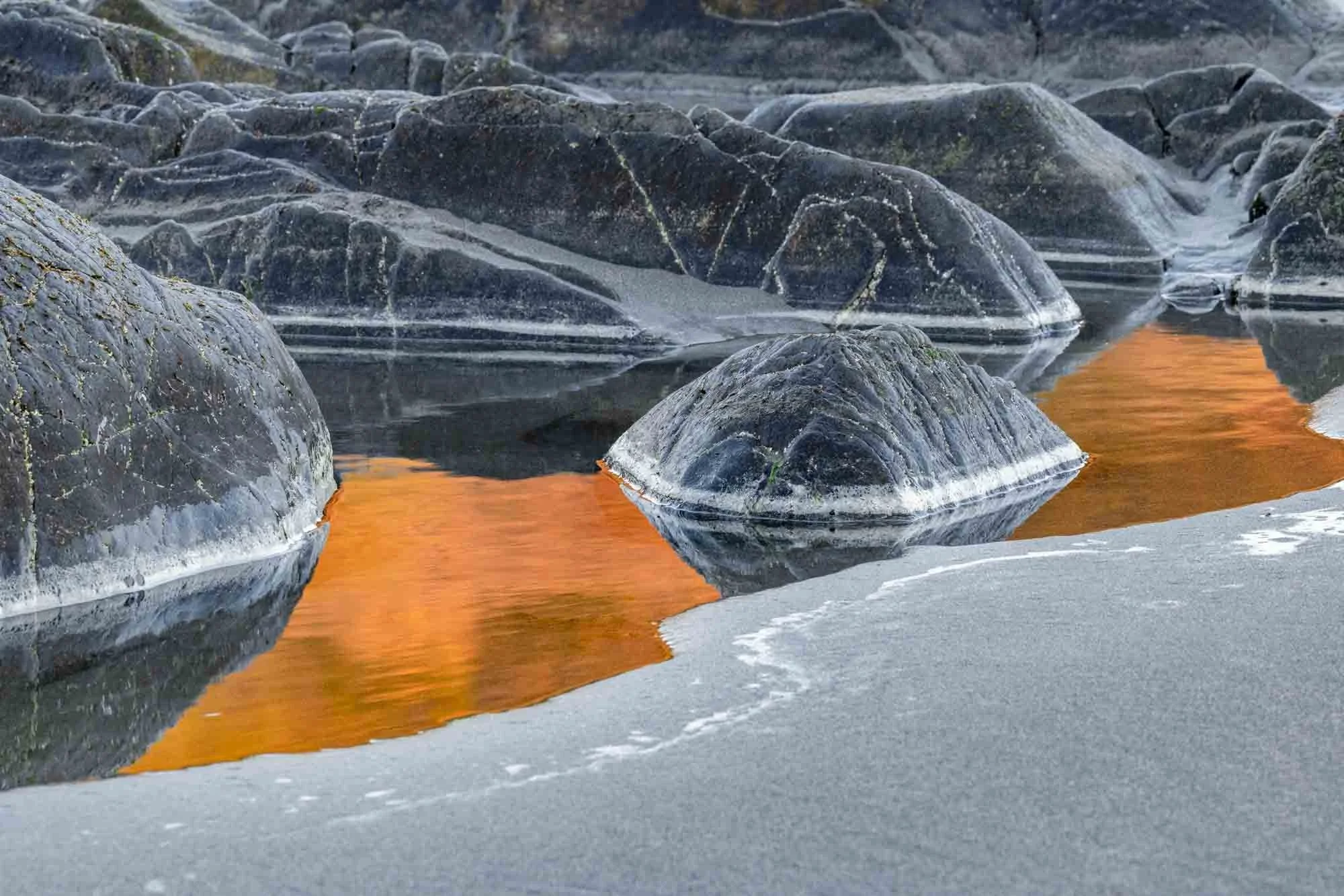
Beach rocks at sunset on Bandon Beach
Sunset colors combined with the standing water rocks on Bandon Beach presented many interesting shapes and color. Usually I look at the huge rocks on the beach to combine with the colors in the sky but today I started to notice small rocks surrounded by still water. I noticed reflections from the rock and wondered what would happen when the sunset colors became reflected in that water. The water was so calm, I reasoned it would make for an interesting photograph.
With an hour before sunset, I had time to look for possible candidates. I carried my tripod while sighting on the rocks and water. The water needed to be calm to reflect the water well. The rocks needed to be large enough to fill the frame. I spent the time looking for the right angles and for interesting rocks. I didn't want simple rocks but ones with patterns.
When the sky started to fill with the colors of sunset, I looked over the couple of rocks that I had identified earlier. The best was rocks with lines and patterns surrounded by water. I got out my tripod and took a series of pictures from different angles. To get what I wanted, I needed to get down low and fill the camera frame. I was surprised that my Canon 100-500mm offered the best framing option and setup quickly.
The rocks on Bandon Beach are part of a tectonic mélange—blocks of harder rock set in a softer matrix that has eroded away. Many of the resistant blocks are blueschist and related metamorphic rocks that formed under high pressure and relatively low temperature during subduction, when oceanic crust was carried deep beneath the continent. Blueschist at Bandon often shows clear banding and foliation: alternating layers rich in glaucophane (the blue amphibole) and other minerals such as epidote or garnet. Those mineral bands form as the rock is deformed and recrystallized under pressure. The result is the linear and curved patterns visible on the surfaces of many of the smaller rocks.
Once the softer surrounding material is removed by waves, the harder blueschist blocks remain as the sea stacks and the smaller rocks scattered across the sand. The lines you see are not sedimentary bedding in the ordinary sense; they are metamorphic fabric—foliation and compositional banding produced while the rock was deep in the subduction zone. Differential weathering then accentuates those lines on the surface. In still water the same rock becomes a dark shape whose white edges and internal patterns contrast with the reflected sunset color. The calm conditions and the low camera angle let both the rock texture and the orange reflection read clearly.
Bringing the Moment to Life
The sunset light really brings out the details of this patterned rock as its white banding and dark surface sit in still water that holds the orange reflection of the sky.
In our studio, I produced this photograph using our Canon imagePROGRAF PRO-1100 and archival Lucia PRO II pigment inks. When printed on Red River Polar Gloss Metallic paper, the details of the subject shine in incredible, smooth tonal depth. The metallic paper beautifully handles those subtle midtones and the contrast of the dark rock against the bright orange water, making the scene pop off the paper without losing any fine detail in the rock lines or the reflection.
Printed with an elegant white border for safe handling and a classic gallery presentation, this piece is flat-shipped in extra-rigid packaging to protect its premium reflective finish.
Bring the story home: Shop Bandon Beach Print
Print Details: Available in 8.5" x 11" Paper (7" x 9" Image) and 11" x 17" Paper (10" x 15" Image).